
Most Robot Mowers Can't Mow at Night — Here's Why LiDAR Changes It (Mammotion LUBA 3)


There's Nothing Like Mowing at Night — But Should Your Robot Mower Do It?
There's a particular kind of satisfaction in it. The neighborhood is dark and quiet, everyone's asleep, and somewhere in your backyard a robot is quietly carving clean, even stripes into your lawn. No engine roar, no weekend afternoon lost to yard work. You wake up, look out the window, and the job is already done.
It's no wonder so many robot mower owners are drawn to the idea of running their machine overnight. It feels like the future working for you while you rest. But before you set that midnight schedule, there are two questions worth answering honestly: is it responsible, and can your mower actually handle the dark? The answers matter more than most people realize — and they're the difference between a flawless overnight cut and a mower stuck against a flowerbed at 3 a.m.
The quiet appeal of mowing at night
Let's start with why night mowing is so appealing in the first place, because the reasons are real.
Your yard is empty after dark. No kids running around, no dog to chase the mower, no foot traffic to interrupt the route. The machine can do its job without a single obstacle that wasn't there yesterday. Robot mowers are already whisper-quiet compared to a gas mower, so running one overnight rarely bothers anyone. You can charge during off-peak electricity hours. And there's the simple pleasure of waking up to a freshly cut lawn with crisp stripes, the whole task handled while you slept.
For a lot of homeowners, that hands-off, set-it-and-forget-it magic is the entire reason they bought a robot mower to begin with. Night mowing is that promise turned all the way up.

But should you? The wildlife question
Here's the part a lot of robot mower content skips, and we won't.
Over the past couple of years, nighttime robot mowing has become a genuine debate — mostly in Europe, and mostly because of hedgehogs. Researchers tested 18 different robot mower models against hedgehogs and found that none of them could detect a small, dependent juvenile, and every model had to physically make contact before it registered the animal at all. Some models caused serious harm. Because hedgehogs are nocturnal and respond to danger by curling into a ball rather than fleeing, a mower running in the dark is a real threat to them.
That research has had teeth. Several German cities, including Bochum and Leipzig, have introduced nighttime restrictions on robot mowers specifically to protect hedgehogs and other small nocturnal animals. It's become a serious enough concern that manufacturers have responded directly.
So if you've seen the headlines and felt a twinge of doubt about running your mower at night — good instinct. That doubt is worth taking seriously.
What this actually means for North American lawns
Now, here's the important context that rarely makes it into those scary headlines: wild hedgehogs are not a North American animal. The entire crisis driving those European bans centers on a species that simply doesn't live in your yard if you're mowing in Pennsylvania, Maryland, Delaware, Virginia, or Colorado.
That doesn't let us off the hook entirely. North American lawns have their own nocturnal residents — toads, frogs, rabbits and their young, ground-nesting birds, and small mammals. A responsible owner thinks about them too. But it does mean the specific panic fueling the European regulations doesn't transfer one-to-one to a backyard in the U.S. The honest takeaway is this: night mowing isn't automatically reckless, but it does deserve a few sensible precautions, which we'll cover below.
Why most robot mowers struggle in the dark
Wildlife aside, there's a purely practical reason most robot mowers shouldn't run at night: a lot of them can't navigate well in the dark.
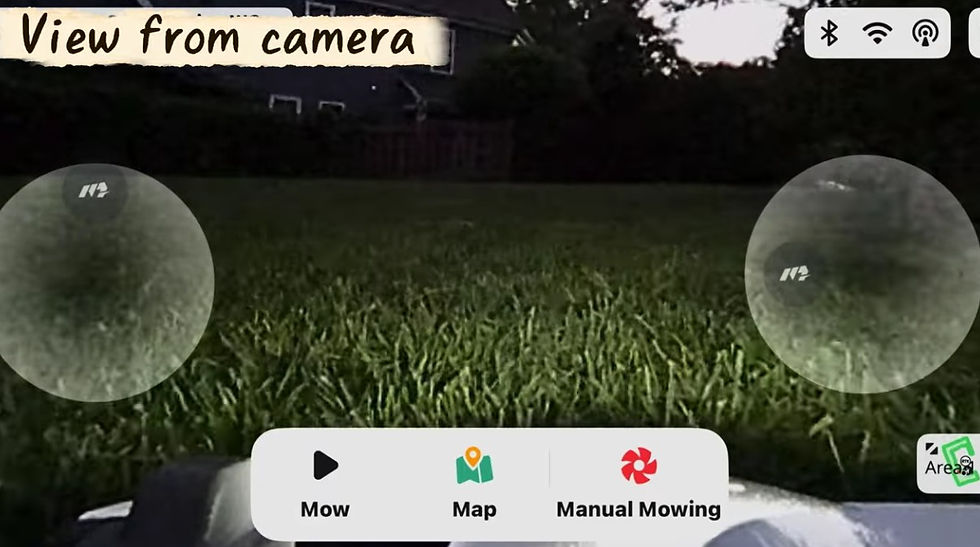
Many robot mowers lean heavily on camera-based vision to find their way and avoid obstacles. Cameras need light. When the sun goes down, vision-dependent mowers get less reliable, and owners report higher "stuck" rates on overnight schedules — the mower wedges itself somewhere and sits there spinning until morning. On top of that, mowers that rely on a satellite RTK signal for positioning can lose their lock at night or in heavy cloud cover, which throws off their accuracy exactly when no one's awake to rescue them.
So for a huge share of the robot mowers on the market, the honest advice is the same as the wildlife advice: just mow during the day. A front-facing LED light helps a camera a little, but it doesn't solve the underlying problem.
There is, however, an exception — and it comes down to one piece of hardware.

How LiDAR changes the game
The robot mowers that genuinely mow well in the dark are the ones built around LiDAR.
LiDAR uses laser ranging to map the world around the mower. Unlike a camera, it does not care whether it's noon or midnight — darkness is simply irrelevant to how it sees. The Mammotion LUBA 3, for example, runs what Mammotion calls its Tri-Fusion navigation system, combining 360-degree LiDAR, AI vision, and network RTK positioning. When the cameras go blind in the dark, the LiDAR carries the navigation load, and the system keeps placing the mower with centimeter-level accuracy.
That's the real reason a LiDAR mower can stripe your lawn at 2 a.m. as confidently as it does at 2 p.m., while a vision-only machine ends up stranded. If reliable night mowing is what you're after, the navigation technology isn't a nice-to-have — it's the whole ballgame. It's also why LiDAR-equipped mowers handle dense tree cover and rain so much better than the alternatives: they're not depending on conditions that the dark, the canopy, or the weather can take away.
How to mow at night responsibly
If you've got the right machine and you want to run it overnight, here's how to do it without cutting corners on safety:
Do a quick lawn walk before a scheduled night run when you can — thirty seconds to check for any animals, toys, or debris goes a long way. Use your mower's wildlife protections: the Mammotion LUBA 3 includes a Wildlife Safety Mode that can either slow the mower down or block nighttime operation entirely, set with a couple of taps in the app, alongside its lighting and bumper protection. Keep your blades at a sensible cutting height and mow frequently rather than letting the grass get long, which keeps each pass gentler.
And if you'd rather put wildlife first and skip the overnight question altogether, that's a completely legitimate choice — there's a mower for that too. Segway Navimow models now default to daylight-only operation, using GPS-based sunrise and sunset times to automatically keep the mower off the lawn at night. Different philosophy, same goal: a great lawn without unnecessary risk.

The bottom line
Mowing at night is one of those robot mower perks that's genuinely as good as it sounds — quiet, hands-off, and weirdly satisfying — as long as two things are true: you're being thoughtful about the wildlife sharing your yard, and your mower is actually built to see in the dark. For most machines, that second part is the dealbreaker. For a LiDAR-equipped mower like the Mammotion LUBA 3, night mowing isn't a gimmick. It's just Tuesday.
If you're trying to figure out whether a robot mower is right for your property — and which one fits how you actually want to use it — that's exactly what we do. Get in touch with Zippy Lawnz for a free lawn assessment, and we'll help you find the machine that matches your lawn, your terrain, and your schedule, day or night.

Frequently asked questions
Can a robot mower mow at night? Some can, most shouldn't. Robot mowers that rely on cameras for navigation struggle in the dark and tend to get stuck, and satellite-RTK positioning can drop its signal overnight. Mowers built around LiDAR, like the Mammotion LUBA 3, navigate just as accurately in the dark as in daylight because LiDAR doesn't depend on light.
Is night mowing dangerous for wildlife? It can be, which is why it's worth thinking about. The biggest concern has been hedgehogs in Europe, which has led several cities there to restrict nighttime mowing. Wild hedgehogs don't live in North America, but other nocturnal animals do, so a quick lawn check before a night run and using your mower's wildlife safety features are smart precautions.
Does the Mammotion LUBA 3 mow at night? Yes. Its Tri-Fusion navigation system pairs 360-degree LiDAR with AI vision and network RTK, so it stays accurate in the dark, under tree cover, and in rain. It also includes a Wildlife Safety Mode that can slow the mower or disable nighttime operation.
Should I just mow during the day to be safe? For many mowers, yes — it's the simplest and safest option, and some models like Segway Navimow default to daylight-only operation for exactly this reason. If you want the option to mow overnight reliably, look specifically for a LiDAR-based mower.
Why does my robot mower keep getting stuck at night? Most likely it relies on camera vision that loses effectiveness in the dark, or an RTK signal that's dropping its satellite lock overnight. A front LED light helps slightly but doesn't fully solve it. LiDAR-based navigation is the reliable fix.
Comments